
Companion Plants
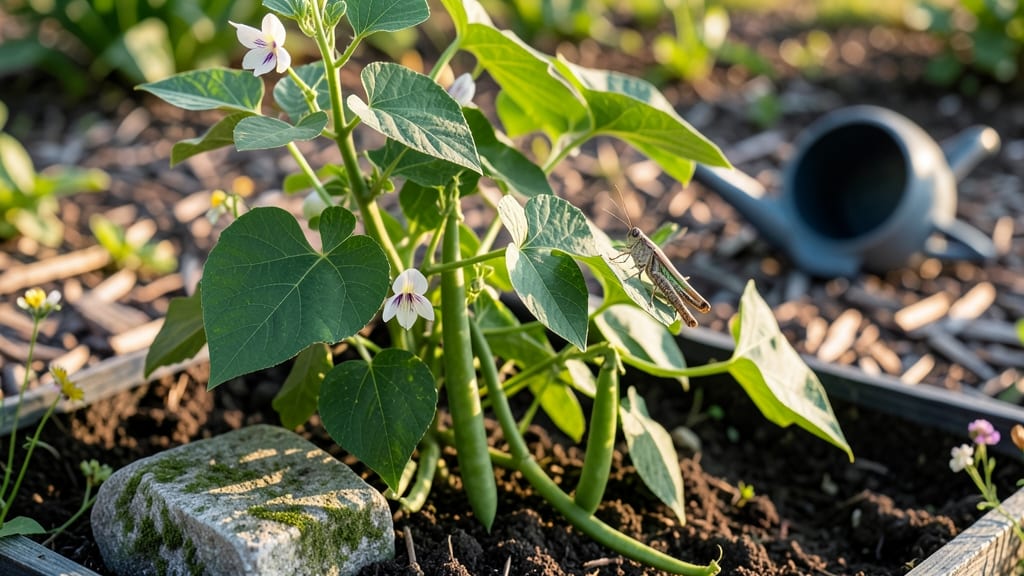
Grasshoppers on plants chew leaves into jagged holes, strip foliage, and weaken stems, often leading to stunted growth or plant death if left uncontrolled. Their feeding can devastate crops, ornamental plants, and young seedlings within days.
When grasshoppers invade your garden, they don't just nibble—they systematically destroy plant tissue using powerful mandibles that slice through leaves like scissors. 🌱 Young plants are especially vulnerable, as their tender stems can't recover from repeated attacks, leading to collapse.
The damage often starts at the edges of leaves, creating distinctive "windowpanes" before progressing to complete defoliation. Unlike caterpillars that chew in neat rows, grasshoppers leave behind irregular, jagged holes and tiny black droppings called frass, which are telltale signs of their presence.
What makes this pest so destructive is their rapid reproduction cycle—some species can go from egg to adult in just 6-8 weeks, turning a minor infestation into a full-blown crisis within weeks. 🌿 They prefer warm, dry conditions, which explains why late summer often brings the worst outbreaks.
The good news? Early intervention with natural predators like spiders, birds, and parasitic wasps can dramatically reduce their numbers without harming your plants.
💡 In This Article
- How Grasshoppers Damage Plants and Identify Their Feeding Patterns
- Top 3 Natural Grasshopper Control Methods for Gardens
How grasshoppers damage plants and identify their feeding patterns
Grasshoppers attack plants using powerful mandibles—paired jaw-like structures that function like scissors, capable of exerting 100-200 psi of force. These mandibles slice through leaf tissue with precision, creating jagged edges rather than the smooth cuts of many other insects.
Their feeding strategy targets young, tender leaves first, as these contain higher moisture and nutrient content, making them easier to digest. 🌿 The damage often begins at leaf margins, where they create small notches that expand inward, leaving behind a characteristic \"windowpane\" effect—thin, translucent areas surrounded by chewed edges.
Their feeding patterns vary by species, but most grasshoppers prefer broadleaf plants like beans, corn, and ornamentals such as roses and marigolds. For example, the differential grasshopper (a common North American species) targets 50+ plant species, while the red-legged grasshopper favors grasses and grains.
What makes their damage so visible is the frass—tiny black pellets of undigested plant material—left behind in clusters near feeding sites. These droppings are a dead giveaway for gardeners, often appearing in 1-2mm clusters along with chewed leaf edges.
The real danger lies in how quickly grasshoppers escalate damage. A single adult can consume up to 17 times its body weight daily, while nymphs (young grasshoppers) are equally voracious. 🌱 When populations explode—often triggered by drought or overgrown vegetation—they can defoliate an entire garden in 3-5 days.
Young plants are especially at risk because their stems can't support the weight of chewed leaves, leading to wilting and collapse. Even mature plants suffer from weakened photosynthesis, stunted growth, and increased susceptibility to diseases.
Identifying grasshopper damage requires looking for specific visual clues. Unlike caterpillars, which leave smooth, linear feeding marks, grasshoppers create irregular, ragged holes with torn edges. You'll also notice skeletonized leaves—where only the leaf veins remain—along with frass scattered on soil or foliage.
Another telltale sign is the presence of exoskeletons (shed skins) left behind as nymphs molt into adults. These clues help distinguish grasshopper damage from other pests like beetles or slugs.
Grasshoppers also exhibit preferred feeding times, typically active during early morning or late afternoon when temperatures are cooler and humidity is higher.
This behavior makes them harder to spot during peak daylight hours. 🌞 Their mobility is another challenge—adults can jump 20 times their body length (about 2 feet in one leap) and fly short distances, allowing them to quickly move between plants.
This agility means they can spread damage across large garden areas within hours.
Understanding these feeding patterns helps gardeners act faster. For instance, early morning inspections of plants like beans or corn often reveal fresh damage, while tall grasses or weeds at garden edges may harbor hidden populations.
By recognizing these patterns, you can implement targeted controls before grasshoppers turn a thriving garden into a skeletonized wasteland.