
Pests
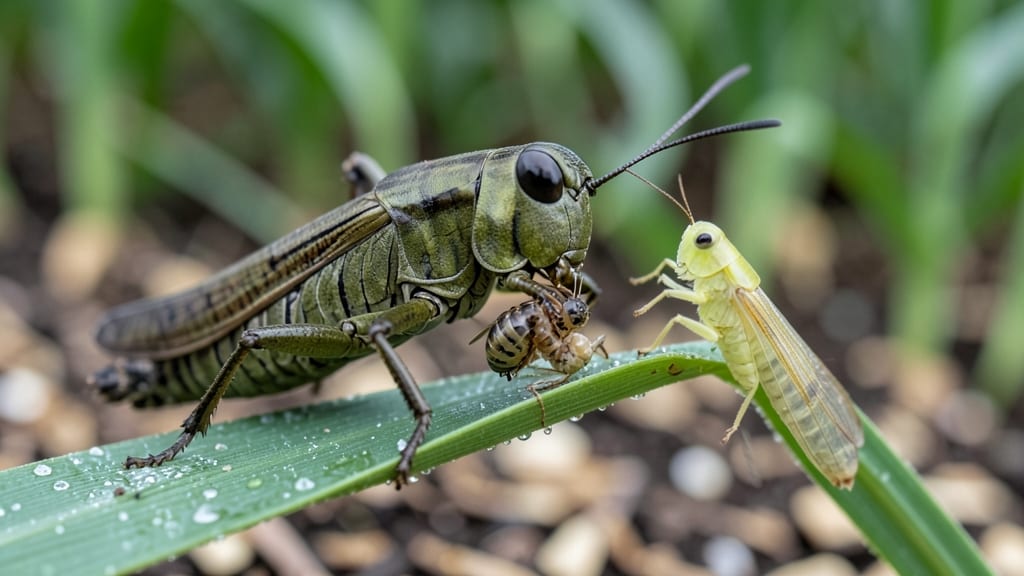
Yes, grasshoppers do eat other bugs, primarily targeting smaller insects like aphids, caterpillars, and young beetles—but they're more likely to munch on plants when given the chance. Their diet flexibility makes them both predators and plant-eaters, depending on what's available in their environment.
Grasshoppers are often seen as plant pests, but their true ecological role is far more complex. 🌿 While they'll happily feast on leaves and stems when plants are abundant, they're also opportunistic hunters that prey on soft-bodied insects like aphids, mealworms, and even smaller grasshopper nymphs.
This dual diet helps them thrive in changing environments, though their impact on gardens depends heavily on local conditions. Younger grasshoppers are particularly insectivorous, while adults shift more toward vegetation as they grow.
What makes this behavior fascinating is how it benefits garden ecosystems. In many cases, grasshoppers act as natural pest controllers by reducing populations of destructive insects like caterpillars and mites.
However, their plant-eating habits can quickly outweigh these benefits during droughts or overpopulation events. The key is understanding their local behavior patterns—where they're helping and where they're causing problems.
💡 In This Article
- Grasshopper Diet Breakdown: Plant vs Insect Prey
- Natural Pest Control: How Grasshoppers Impact Garden Ecosystems
Grasshopper diet breakdown: plant vs insect prey
Grasshoppers exhibit a fascinating dietary duality, functioning as both predators and herbivores depending on environmental conditions. Studies show that approximately 60-70% of their diet consists of plant material when vegetation is abundant, but this shifts dramatically when insect populations spike.
Their mandibles are uniquely adapted for both chewing tough plant fibers and gripping soft-bodied prey, with serrated edges that can slice through insect exoskeletons while also processing fibrous stems.
The predatory behavior is most pronounced in younger nymphs, which consume up to 80% insects during their early developmental stages. Their preferred insect targets include aphids (a favorite due to their high nitrogen content), caterpillars, and young beetles—prey they can overpower with their strong hind legs.
Interestingly, grasshoppers exhibit what scientists call "functional response" behavior: when insect populations increase, their predatory habits intensify, sometimes reaching 40-50% of their diet during outbreaks.
What's particularly intriguing is how habitat availability dictates this balance. In grasslands where vegetation dominates, grasshoppers may eat less than 10% insects, while in agricultural fields or gardens with dense insect populations, their predatory tendencies become much more pronounced.
This adaptability makes them ecological generalists—able to thrive in diverse environments by shifting their diet based on what's most abundant.
Temperature also plays a crucial role in their feeding patterns. Research shows that grasshoppers become more insectivorous in cooler conditions (below 75°F), likely because plant growth slows and insects become more accessible.
Conversely, during hot, dry periods when plants become scarce, they'll consume up to three times more insects than during peak growing seasons. This temperature-driven behavior helps explain why they're sometimes seen as beneficial predators in early spring but destructive herbivores in late summer droughts.
One fascinating adaptation is their ability to detect prey through vibrations. Grasshoppers possess specialized sensory hairs on their legs that can detect the tiny movements of struggling insects, allowing them to locate and capture prey with remarkable efficiency.
This sensory mechanism is particularly effective against soft-bodied insects like aphids, which make minimal escape attempts. 🔥 The combination of this predatory skill with their plant-eating habits creates a complex ecological role that benefits both garden ecosystems and natural pest control cycles.
Consider the case of the differential grasshopper (Melanoplus differentialis), which has been studied extensively in agricultural systems. Researchers found that when aphid populations exceeded 50 per square foot, these grasshoppers would consume up to 200 aphids per day—effectively acting as natural pest controllers.
Yet in the same fields during drought years, they'd switch to eating 90% plant material, causing significant crop damage. This dual behavior highlights why understanding their local diet patterns is essential for effective pest management.