
Companion Plants
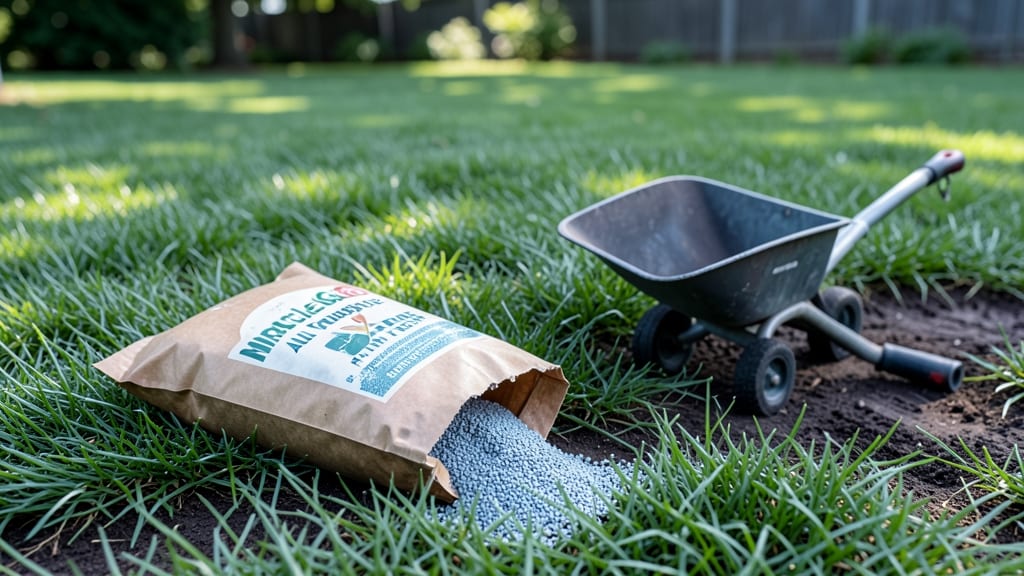
You can use Miracle-Gro plant food on grass in moderation, but it requires careful dilution and testing to prevent nitrogen buildup, lawn burns, or stunted growth. Always reduce the concentration to half-strength before applying.
Miracle-Gro's concentrated formula delivers fast results for flowering plants, but its high nitrogen content can overwhelm grass roots if applied directly. 🌱 The key is balancing its synthetic nutrients with your lawn's needs—too much creates thatch buildup or yellowing patches.
I recommend spot-testing on a small area first, especially during hot weather when grass is more vulnerable to chemical stress. For best results, apply in early spring or fall when grass is actively growing but not under heat stress.
Instead of relying solely on Miracle-Gro, consider mixing it with a grass-specific fertilizer (like 24-0-4) for a safer NPK ratio. This combination gives you the benefits of Miracle-Gro's fast-acting nutrients while protecting your lawn's long-term health.
Always water thoroughly after application to help nutrients penetrate the soil rather than sitting on the surface.
💡 In This Article
- How Miracle-Gro Fertilizer Affects Grass Roots and Growth
- Safe Application Tips for Using Miracle-Gro on Lawns
How Miracle-gro fertilizer affects grass roots and growth
Miracle-Gro's formula is engineered to deliver fast nutrient uptake, but its high nitrogen content (typically 24-30% nitrogen in its concentrated form) is where the risk lies for grass.
This synthetic nitrogen—primarily in ammonium and nitrate forms—stimulates rapid top growth, but without proper dilution, it can overwhelm grass roots by disrupting their natural balance of nitrogen, phosphorus (4-8%), and potassium (8-12%).
Grass roots need a more gradual nutrient release to develop strong, deep systems for water and nutrient absorption.
The problem gets worse in hot weather when grass blades already struggle to process excess nitrogen efficiently.
You'll often see yellowing patches or a rubbery texture in the grass—signs of nitrogen toxicity—because the roots can't keep up with the nutrient demand. 🌱 What's happening chemically is that the high nitrogen creates an osmotic imbalance in the root cells, forcing them to work overtime just to absorb water, which can lead to root burn if the concentration is too strong.
Another critical factor is how Miracle-Gro's synthetic nutrients interact with soil microbes. Grass lawns thrive on a balanced ecosystem of beneficial bacteria and fungi that help break down organic matter.
While Miracle-Gro provides immediate nutrients, it can temporarily suppress these microbes by altering soil pH slightly (usually making it more acidic) and overwhelming their natural nutrient cycling processes. Over time, this creates a dependency on synthetic inputs rather than building soil fertility organically.
For comparison, most grass-specific fertilizers use a 24-0-4 NPK ratio with slower-release nitrogen forms like urea or polymer-coated urea, which are gentler on roots. Miracle-Gro's quick-release nitrogen is better suited for flowering plants that need rapid blooming, not the steady growth pattern of grass.
The key difference is that grass benefits more from a balanced 3-1-2 NPK ratio (nitrogen-phosphorus-potassium) that supports both top growth and root development.
What most people don't realize is that the phosphorus content in Miracle-Gro (typically 4-8%) is actually beneficial for grass roots, but it's the nitrogen that becomes problematic. The phosphorus helps strengthen root systems and improve drought resistance, but only when applied in proper proportions.
When you dilute Miracle-Gro to half-strength, you're essentially creating a more grass-friendly NPK profile while still getting some of the phosphorus benefits.
One visual telltale sign of overapplication is when grass blades develop a dark green color that looks almost artificial. This happens because the high nitrogen causes excessive chlorophyll production, but the roots can't support this unnatural growth rate.
In extreme cases, you might even see white, crusty deposits on the soil surface—this is salt buildup from the fertilizer's minerals, which further stresses the roots by increasing soil salinity.